Course Details
| Compressible Flow TME085 | |
| Credits | 5.0 credit points (7.5 ects) |
| Grading scale | fail, 3, 4, 5 |
| Educational level | Master course |
| Main field | Mechanical Engineering |
| Master's program | Applied Mechanics |
| Department | English |
| Teacher Team | |
| Niklas Andersson | Examiner/Lecturer |
| Huadong Yao | Lecturer |
Objectives
The main objectives of the course are to convey to the students an overview of and familiarity with the field of compressible flows and the importance of this topic in the context of common engineering applications. This means that the student should acquire a general knowledge of the basic flow equations and how they are related to fundamental conservation principles and thermodynamic laws and relations. The connections with incompressible flows and aero-acoustics as various limiting cases of compressible flows should also become clear. A general knowledge of and some experience with typical CFD codes for compressible flows should also be obtained after this course.
Intended Learning Outcomes
After the completing the course, each student should be able to:
- Define the concept of compressibility for flows
- Explain how to find out if a given flow is subject to significant compressibility effects
- Describe typical engineering flow situations in which compressibility effects are more or less predominant (e.g. Mach number regimes for steady-state flows)
- Present at least two different formulations of the governing equations for compressible flows and explain what basic conservation principles they are based on
- Explain how thermodynamic relations enter into the flow equations
- Define the special cases of calorically perfect gas, thermally perfect gas and real gas and explain the implication of each of these special cases
- Explain why entropy is important for flow discontinuities
- Derive ( marked) and apply (all) of the presented mathematical formulae for classical gas dynamics
- 1D isentropic flow
- Normal shocks
- 1D flow with heat addition
- 1D flow with friction
- Oblique shocks in 2D
- Shock reflection at solid walls
- Contact discontinuities
- Prandtl-Meyer expansion fans in 2D
- Detached blunt body shocks, nozzle flows
- Unsteady waves and discontinuities in 1D
- Basic acoustics
- Solve engineering problems involving the above-mentioned phenomena (8.a - 8.k)
- Explain how the incompressible flow equations are derived as a limiting case of the compressible flow equations
- Explain how the equations for aero-acoustics and classical acoustics are derived as limiting cases of the compressible flow equations
- Explain the main principles behind a modern Finite Volume CFD code and such concepts as explicit/implicit time stepping, CFL number, conservation, handling of compression shocks, and boundary conditions
- Apply a given CFD code to a particular compressible flow problem
- Analyse and verify the quality of the numerical solution
- Explain the limitations in fluid flow simulation software
- Report numerical analysis work in form of a technical report
- Describe a numerical analysis with details such that it is possible to redo the work based on the provided information
- Write a technical report (structure, language)
- Search for literature relevant for a specific physical problem and summarize the main ideas and concepts found
- Present engineering work in the form of oral presentations
Course Literature
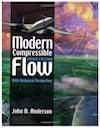 Modern Compressible Flow with Historical Perspective
John D. Andersson
3rd revised edition
McGraw-Hill 2004
ISBN: 0071241361
| Chapter 1 | Compressible Flow |
| Chapter 2 | Integral Forms of the Conservation Equations for Inviscid Flows |
| Chapter 3 | One-Dimensional Flow |
| Chapter 4 | Oblique Shocks and Expansion Waves |
| Chapter 5 | Quasi-One-Dimensional Flow |
| Chapter 6 | Differential Conservation Equations for Inviscid Flows |
| Chapter 7 | Unsteady Wave Motion |
| Chapter 12 | The Time-Marching Technique |
| Chapter 16 | Properties of High-Temperature Gases |
| Chapter 17 | High-Temperature Flows |
Course Outline
In the course there are in total 15 lectures and seven sessions with exercises. There are also three compulsory numerical assignments involving problem solution based on classical formulae and/or numerical methods. One of these assignments, referred to as The Compressible Flow Project, spans over all eight course weeks and includes a literature survey part and a hands-on numerical assignment. The project is done in groups of up to four students and should be presented in form of a technical report (mandatory) at the end of the course. There is also a mandatory oral-presentation session in the end of the course where each of the groups presents their approach to solve their specific problem and their major findings. The numerical tools used in the course consist of a Matlab code for 1D compressible flow and the commercial code ANSYS-FLUENT for 2D compressible flow.

Assignments
Important!
Each Student following the Compressible Flow course should sign up for one of the 12 project groups available in PingPong. Each group will work with one of six available cases. The connection between group number and case is indicated in the case list below where also a short description of each of the cases can be found.
No more than two groups will be allowed to work on the same case and the number of group members in each group is limited to four first come first serve
| Computer Assignments | |
| Assignment 1 | One-dimensional compressible flow with heat addition and friction: numerical simulations done using a Matlab script provided alongside with the instructions. |
| Assignment 2 | Two-dimensional flow past a symmetrical diamond wedge airfoil: numerical simulations done using the commercial CFD solver ANSYS-FLUENT |
| Assignment 3 | Quasi-one-dimensional flow: Nozzle simulations done in Matlab Unsteady wave motion |
| The Compressible Flow Project | |
In addition to the assignments listed above, there is a quite extensive project course element in the course.
The list below describes the outline of the project in short. More detailed instructions can be found
here
|
|
|
Case 1 (Groups 01 & 07) Inviscid flow through engine intake: The flow field inside a supersonic engine intake (SR-71 Blackbird) will be calculated both analytically and numerically. The flow is assumed to be steady and two-dimensional. |
|
|
Case 2 (Groups 02 & 08) Unsteady and steady inviscid compressible flow around airfoil: The unsteady flow developing around an airfoil after an impulsive start will be simulated numerically. The solution should (after some time) converge towards a steady-state flow condition. The flow is assumed to be two-dimensional. In addition, a supercritical airfoil is investigated and results are compared. |
|
|
Case 3 (Groups 03 & 09) Inviscid compressible under-expanded nozzle flow: The steady state flow in and outside of a convergent nozzle including possible shocks downstream of the nozzle will be calculated numerically. The flow is assumed to be steady, two-dimensional, and axisymmetric. |
|
|
Case 4 (Groups 04 & 10) Inviscid compressible over-expanded nozzle flow: The steady state flow in and outside of a convergent-divergent nozzle including possible shocks inside and downstream of the nozzle will be calculated numerically. The flow is assumed to be steady, two-dimensional, and axisymmetric. |
|
|
Case 5 (Groups 05 & 11) Inviscid linear compressor cascade: The flow field inside a linear compressor cascade will be calculated numerically. All blades in the cascade are identical and therefore it is sufficient to simulate the flow in one blade passage. The flow is assumed to be two-dimensional and steady. |
|
|
Case 6 (Groups 06 & 12) Supersonic flow over a bi-convex airfoil: The supersonic flow over a bi-convex airfoil is investigated both numerically and analytically. The numerical predictions are compared with the analytical solution and available experimental data. |
|
Important Dates
| 2016-02-12 | Hand in of literature survey report |
| 2016-02-22 | Hand in of preliminary results |
| 2016-02-25 | Last day to sign up for the exam |
| 2016-03-01 | Guest lectures |
| 2016-03-08 | Oral presentation session (mandatory attendance) |
| 2016-03-11 | Hand in of project report |
| 2016-03-17 | Exam |
| 2016-03-16 | Last day to sign up for the re-exam I |
| 2016-04-04 | Re-exam I |
| 2016-07-28 | Last day to sign up for the re-exam II |
| 2016-08-17 | Re-exam II |
Examination
The examination is based on a written test (fail, 3, 4, 5), passed assignments, three computer labs and one larger project. The project may give up to seven bonus points for the written exam if all the assessment criteria are fulfilled. The written exam is divided into one part (part I) with theory questions (20 p.) and one part (part II) with problems to solve (40 p.).
| grade | 3 | 4 | 5 |
| number of points on the exam | 24-35 | 36-47 | 48-60 |
Notice!
In addition to the tabulated grade limits, it is required that at least 8 of the total number of points are in the theory question part of the exam (Part I) and at least 12 points in the problem part (Part II)